Friday, August 13, 2010

Question 5 E-Learning

Question:
ABCD is a parallelogram. If E is midpoint of AD and  F is midpoint of BC show, with reasons, that BFDE must be a parallelogram.
Answer:
The line BF is parallel to the line ED and the line BE is parallel to line FD.
There are 2 pairs of parallel lines so BFDE is a parallelogram.

Question 4 E-Learning

Question:
‘All parallelograms are squares?’ Do you agree with this statement?
Justify your answer with example/s.

Answer:
Not all parallelograms are squares as all the angles in a square must 
be 90 degrees.

Question 3 E-Learning


Question 3:
A quadrilateral is drawn on a piece of paper. It has one pair of opposite sides equal in length, the other pair not equal in length, and a pair of opposite angles that are supplementary1Identify this figure, and justify your answer with reasons.
sum of two angles equals 1800

It is a trapezoid as it is the only quadrilateral with one pair of parallel lines and it is called an Isosceles Trapezoid.

Question 2 E-Learning


Question:
Which of the given statements is correct? Justify your answer/s with examples.
A ) A square and a parallelogram are quadrilaterals.
B ) Opposite sides of a square and a parallelogram are parallel.
C ) A trapezoid has one pair of parallel sides.
D ) All the above

Answer:
The answer is D.
A square and a parallelogram, both have four sides.
The trapezoid has only one pair of parallel lines but they are not equal in length.


Question 1 E-Learning

‘A square is a rhombus but a rhombus is not a square’.


The statement above is true because a rhombus has 2
pairs of parallel lines and the length of each side is the 
same and this also applies for the square.
Not all rhombus are squares.

Tuesday, August 3, 2010

ICT Linear Equation


Cartesian coordinate system

Co-ordinate systems are usually written in pairs.
The are two co-ordinates : X co-ordinate
                                               Y co-ordinate

The x co-ordinate tells us how many units to go left or right.
The y co-ordinate tells us how many units to go up or down.
Both of the co-ordinates helps us determine negative(Down and left) and positive numbers
(Up and right).
This system was developed by Rene Descartes in 1637.
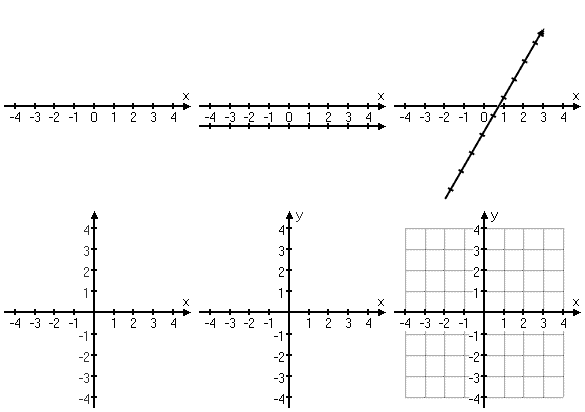
The number lines, when drawn like this, are called "axes". The horizontal number line is called the "x-axis" ; the vertical number line is the y-axis.
The Cartesian Plane is a plane with a rectangular coordinate system that associates each point in the plane with a pair of numbers.